Genes set susceptibility
Not every follicle responds to androgen signaling in the same way.

Men's hair loss
Hairline recession, crown thinning, shedding and patchy loss are not interchangeable. Learn what each pattern can mean and where personalized care begins.
A normal hormone. Pattern loss depends on genetically susceptible follicles and androgen signaling.
DHT, explained
Not every follicle responds to androgen signaling in the same way.
Terminal hairs can shift toward finer and shorter fibers.
Age, stage and consistency influence the individual timeline.
Sudden patches or inflammation should pause a practitioner-led box recommendation.
Pattern guide

Male pattern hair loss often begins with recession at the temples. A gradual, symmetric change differs from a sudden patch or inflamed edge.
Pattern 01
Crown thinning can expand gradually as genetically susceptible follicles produce finer, shorter hairs over repeated cycles.
Pattern 02
Diffuse thinning can occur in pattern loss, but sudden all-over shedding may also follow illness, stress, weight change or medication changes.
Pattern 03
Pattern hair loss follows recognizable scalp regions because susceptible follicles can respond differently over repeated cycles.
TestosteroneA normal androgen hormone
5-alpha-reductaseThe enzyme involved in conversion
DHTBinds androgen receptors throughout the body
Susceptible follicleCan miniaturize over repeated growth cycles
Visible patternOften temples, crown and top
The issue is follicle sensitivity, not simply too much testosterone.TestosteroneA normal androgen hormone
5-alpha-reductaseThe enzyme involved in conversion
DHTBinds androgen receptors throughout the body
Susceptible follicleCan miniaturize over repeated growth cycles
Visible patternOften temples, crown and top
The issue is follicle sensitivity, not simply too much testosterone.

Interactive pattern explorer
Temples
Male pattern hair loss often begins with recession at the temples. A gradual, symmetric change differs from a sudden patch or inflamed edge.
Education, not diagnosisIllustrative journey
Standardized progress review
Use the same angle, lighting and hair length so later comparisons are not distorted by presentation.
Use the same angle, lighting and hair length so later comparisons are not distorted by presentation.
Generated simulation, not a customer result. Response depends on the cause, treatment, consistency and individual biology; some forms of hair loss do not regrow.
Progress photography is most useful when the presentation stays consistent. These generated phases demonstrate a review method, not a customer result or a guaranteed outcome.
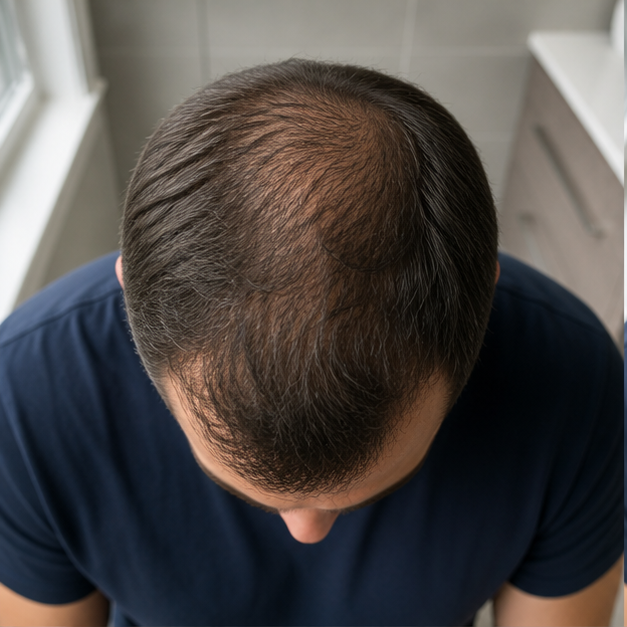
Record the visible pattern before changing the routine.
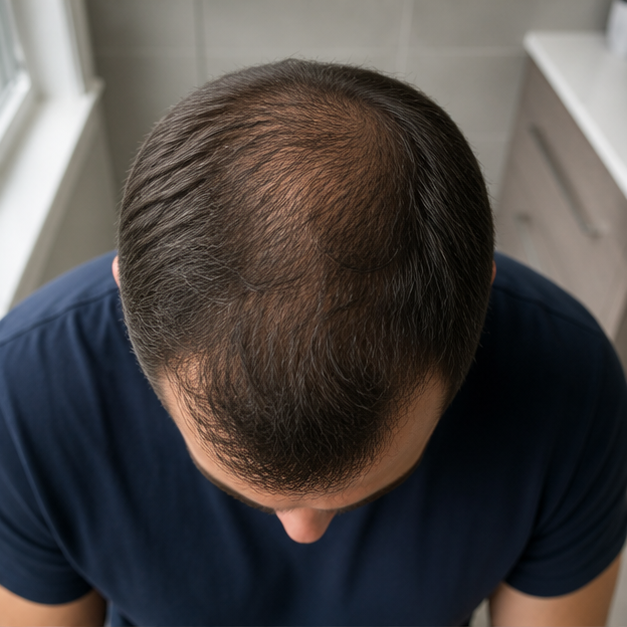
An early checkpoint is useful for routine fit, not a result deadline.
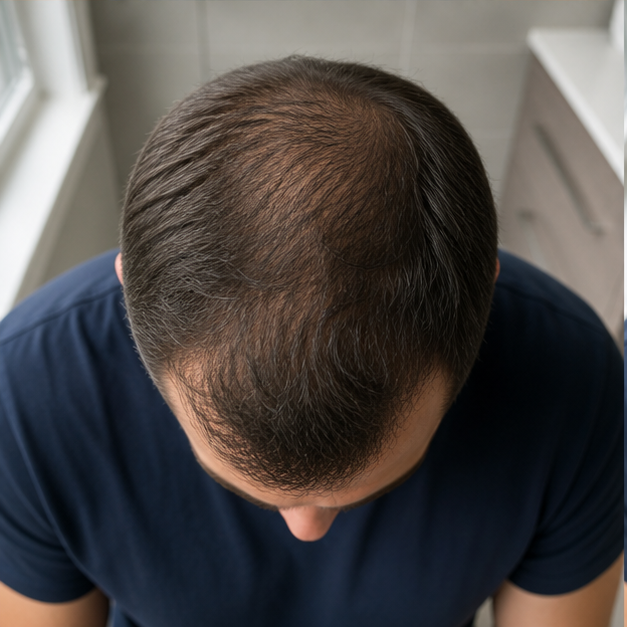
Use the same angle, part, hair length, wash timing and light.
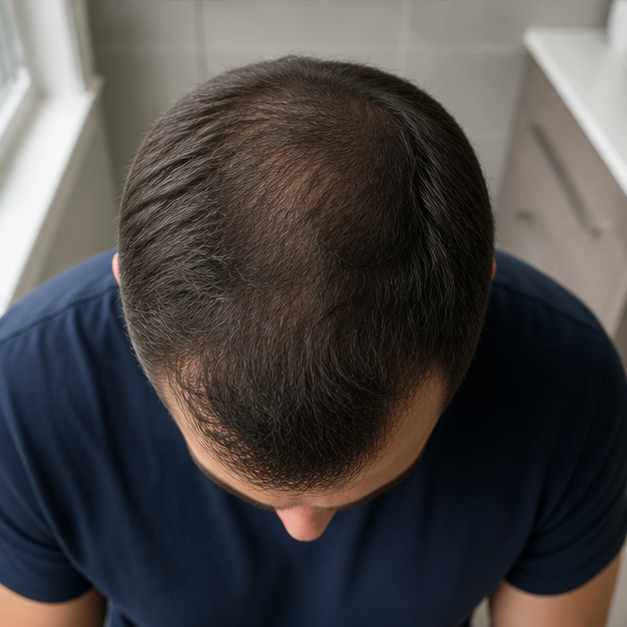
Review direction, tolerance and whether an Inruut practitioner should pause or adjust the route.

Cosmetic support, OTC medication, prescription care and nutrition have different roles, evidence and suitability requirements.
Explore the science
A cleanser matched to oil and wash frequency, a direct scalp step and conditioning kept on the lengths.
Explore the scienceMatch the tool to the cause.
Gentle care can support the scalp and reduce breakage. It does not change genetics, and supplements are not automatically useful.

These changes sit outside an Inruut wellness profile. The responsible route is an outside licensed medical assessment before adding products or tools.
Review care guidance
Seven questions organize pattern, timing, scalp, routine and goal without pretending to diagnose.
Take the hair quiz